 Skip to content

Shankhpushpi: The Complete Guide to Ayurveda, Science, Benefits & Dosage
- Written by Dr. Rajshree Singhatiya
- 6 min read
- Expert Medically Reviewed by Dr. Urvi Ashani, M.Pharm (Ayurveda), Ph.D | R&D Head, BabyOrgano | 13+ Years Experience in Pediatric Ayurvedic Care
Table of Contents
For those of us who grew up in households where Ayurveda was just part of life, Shankhpushpi isn't new. This blog is going to cover everything. Botany, science, Ayurvedic roots, right dosages, safety profile, and side effects.
What Is Shankhpushpi And Why Is Its Identity So Complicated?
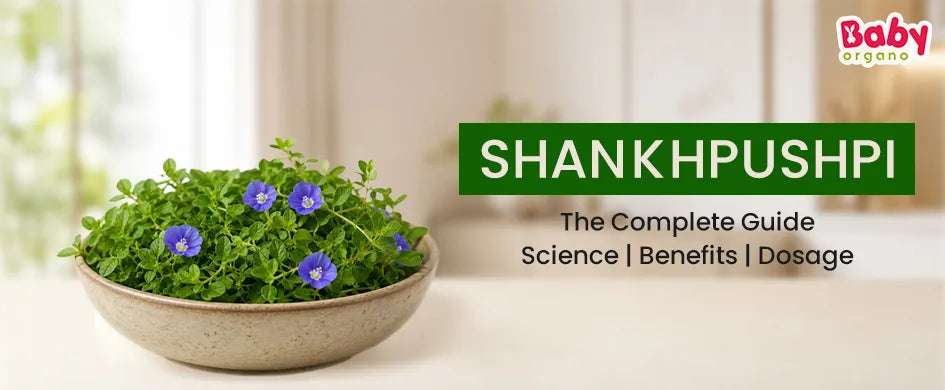
Shankhpushpi translates to "the plant with flowers shaped like a conch shell" where Shankha means conch and Pushpi means flower. If you've ever seen the delicate, spiral blooms of Convolvulus pluricaulis (also spelled Convolvulus prostratus), you'd immediately get the reference. The flowers are small, purplish-white, and curl in a way that resembles the sacred shankh used in Hindu rituals.
In different parts of India, you'll hear it called Sankhahuli in Hindi, Shankhavali in Marathi, Vishnukranthi in Tamil, and Krishnakranti in Bengali, the regional names vary but the reverence remains consistent.
4 Plants Are Sold as Shankhpushpi in India but Only One Is Authentic
This is where things get interesting because across India, four different plant species are all sold under the Shankhpushpi label:
- Convolvulus pluricaulis (synonym: Convolvulus prostratus)
- Evolvulus alsinoides
- Clitorea ternatea (the Blue Pea flower)
- Canscora decussata
All of them have some cognitive or nervine properties. All of them have been used in traditional Ayurvedic practice in different regions. But they are not the same plant, and they don't have identical chemical profiles.
So which one is the "real" Shankhpushpi?
Ayurvedic Pharmacopoeia of India (API) (country's official regulatory reference for Ayurvedic plants) states Convolvulus pluricaulis is the authentic, gold-standard Shankhpushpi for cognitive development.
What Are the Active Compounds in Shankhpushpi and What Do They Do?
Ayurveda has trusted this plant for millennia, but modern phytochemistry has started catching up and what it's found is genuinely fascinating.
Bioactive Compounds
Convolvulus pluricaulis contains a rich phytochemical cocktail:
Alkaloids (including shankhpushpine, convolvine, convolamine, and phyllabine) - These nitrogen-containing compounds are largely responsible for the plant's neurological actions.
Flavonoids (including kaempferol and its derivatives) - Flavonoids contribute heavily to the plant's antioxidant and neuroprotective effects.
Coumarins - Coumarins have shown mild anti-anxiety and sedative-like properties in pharmacological studies.
Steroids and triterpenoids - Compounds linked to the herb's adaptogenic and anti-inflammatory profile.
Glycosides - Glycosides influence cellular signaling and contribute to cardioprotective effects.
Dendritic Arborization
Here's where modern neuroscience backs Ayurvedic tradition in a beautiful way. Research published in peer-reviewed journals (including studies indexed on PMC and ScienceDirect) has shown that Convolvulus pluricaulis actively promotes dendritic arborization (when brain cells grow more branches to connect with each other) in brain cells.
Neurons (brain cells) communicate with each other through branching extensions called dendrites. The more branches a neuron has, the more connections it can form, and the more efficiently it can transmit information. Shankhpushpi appears to encourage neurons to grow more of these branches, expanding the brain's communication network at a cellular level.
Neurotransmitter Regulation
Shankhpushpi has also been shown to increase acetylcholine (primary neurotransmitter involved in learning, memory consolidation, and recall) levels in the brain. People with Alzheimer's disease consistently show depleted acetylcholine activity which is why one of the main drug classes for the condition works by inhibiting acetylcholinesterase (an enzyme that breaks acetylcholine down).
Shankhpushpi does something similar, naturally. It acts as an acetylcholinesterase inhibitor, which means it prevents the rapid breakdown of acetylcholine and keeps it active longer in the synaptic cleft (the tiny gap between two brain cells where signals are passed).
More acetylcholine activity = sharper memory = faster recall.
Cortisol Regulation
Stress is one of the biggest enemies of brain function. Chronic cortisol elevation that comes with anxiety, burnout, or even through pressure genuinely degrades neuronal health over time.
Shankhpushpi has been found to downregulate the HPA (hypothalamic-pituitary-adrenal) axis, which is the central command system for your stress response. By modulating this axis, it actively suppresses excess cortisol production.
Less cortisol = less neuroinflammation = clearer thinking and better memory retention.
Shankhpushpi in Ayurvedic Texts

If you study Dravyaguna Vigyan (the Ayurvedic science of plant pharmacology), Shankhpushpi occupies a very specific and elevated position.
The Charaka Samhita's Decree
Acharya Charaka, the foundational Ayurvedic physician whose Charaka Samhita remains relevant more than 2,000 years after it was composed, classified four plants as Medhya Rasayanas (herbs that rejuvenate and strengthen the intellect). These four are Mandukaparni (Gotu Kola), Yashtimadhu (Licorice), Guduchi, and Shankhpushpi.
But here's the distinction that sets Shankhpushpi apart from even its peers. Charaka explicitly writes: "Shankhpushpi Visheshatvam Medhya" (specifically, Shankhpushpi [is the best for intellect]). This establishes Shankhpushpi as uniquely potent for cognitive enhancement among these foundational brain-rejuvenating herbs.
Ayurvedic Pharmacological Properties (Dravyaguna)
In classical Ayurvedic property taxonomy:
Rasa (Taste): Tikta (Bitter) Bitter-tasting herbs, in Ayurvedic logic, tend to be cooling, drying, and deeply detoxifying for the nervous system.
Guna (Qualities): Snigdha (oily, unctuous) and Picchila (smooth, somewhat sticky). These qualities make it deeply nourishing and protective for nerve tissue which needs consistent lubrication to function well.
Virya (Potency): Sheeta (Cooling). Shankhpushpi cools both the physical body and the nervous system. This is why it's so effective for Pitta-aggravated conditions like mental heat, anger flares, frustration, and burnout.
Vipaka (Post-Digestive Effect): Madhura (Sweet) meaning its action after digestion is nourishing, building, and restorative.
Dosha Karma: Tridoshahara, balancing to all three doshas but its strongest and most targeted action is on Vata (restlessness, anxiety, scattered thinking) and Pitta (mental heat, irritability, stress-induced cognitive decline) in the brain and nervous system.
Benefits of Shankhpushpi

Memory, Concentration, and Faster Recall
Consistent daily use of Shankpushpi tends to produce measurable shifts in how quickly information is absorbed and how reliably it's retrieved because the brain works with better neurochemical support.
For parents specifically, introducing a good Shankhpushpi syrup for their child often comes with a noticeable reduction in mental scatter and better ability to sit down and actually retain what's being studied.
Stress, Anxiety, and Nervous Exhaustion
Shankhpushpi for anxiety works through the cortisol regulation pathway as it's a genuine adaptogen, meaning it helps the body resist the physiological effects of chronic stress rather than simply sedating the nervous system. A sedative makes you feel less but an adaptogen helps your nervous system function better under pressure.
This makes it relevant for a wide range of people like children, teenagers, and adults. The nervous system doesn't care how old you are when it's overwhelmed, and neither does Shankhpushpi.
ADHD, Hyperactivity, and Attention Difficulties
The phrase most associated with Shankhpushpi's action here is "alert calmness" and it applies beyond just children with diagnosed ADHD. Adults who struggle with attention dysregulation, chronic restlessness, or an inability to stay on task also report meaningful improvement with consistent use.
That said, this is where the herb has gained particular traction in modern parenting conversations. Children dealing with hyperactivity, impulsive behavior, or sustained attention difficulties have increasingly been supported with Shankhpushpi as part of a holistic approach. It doesn't replace professional guidance, but as a complementary support, the tradition is old and the neurological rationale is sound.
Speech, Articulation, and Neurological Communication
This application surprises people because it sits slightly outside the standard memory and focus conversation but speech and language are fundamentally neurological functions and a herb that supports nerve development, reduces cognitive anxiety, and improves neurotransmitter activity naturally has downstream effects on verbal clarity and articulation.
Classically, this use was documented for children with speech delays, particularly in combination with Vacha and Gotu Kola. But the same neurological pathway applies to adults dealing with word retrieval difficulty, verbal hesitation under stress, or communication confidence issues tied to anxiety.
Restful Sleep
Shankhpushpi approaches sleep differently from pharmaceutical sleep aids and the difference is significant. Rather than sedating you into unconsciousness, it quiets the mental loop of thoughts and worries which results in preventing a tired mind from switching off. The result is sleep that feels earned and restorative, without the grogginess or chemical dependency that comes with conventional sleep medications.
Secondary Systemic Benefits
Beyond the brain and nervous system, Shankhpushpi also supports:
- Blood pressure regulation
- Heart health
- Digestive ease
- Skin health
Forms of Shankhpushpi

Shankhpushpi Syrup
For children, this is the most practical and widely used form. Powder is hard to get kids to take and capsules are impossible for toddlers. Parents who've tried everything else often find that Shankhpushpi syrup is the single change that gets the herb into a child's system consistently.
Shankhpushpi Churna (Powder)
Shankhpushpi churna is typically consumed with warm milk, honey, or ghee - the anupana (carrier) approach. It's the most cost-effective form and delivers the whole-plant profile of constituents.
Standardized Capsules and Extracts
Shankhpushpi capsules offer the most precise dosing and are popular with working professionals who want convenience without complexity. Standardized extracts ensure a consistent concentration of active alkaloids, useful if you want predictable, measurable effects.
Ayurvedic Compound Formulations
Shankhpushpi appears as a key ingredient in several classical compound preparations that Ayurvedic physicians prescribe for deeper neurological support:
Saraswatarishta - Perhaps the most well-known classical formulation for intelligence, speech, and memory. Contains Shankhpushpi alongside Brahmi, Vacha, Ashwagandha, and several other nervine herbs.
Shankhpushpi Rasayana - A medicated ghee preparation used for intensive cognitive restoration.
Medhya Kashaya - A traditional decoction that combines the four Medhya Rasayanas for comprehensive brain support.
Shankhpushpi Dosage Guide: Age-Wise Recommended Doses
Toddlers (1–3 Years)
This age group requires the most caution. Shankhpushpi in classical Ayurveda has traditionally been given to very young children only as fresh herb juice in micro-drops, strictly under the supervision of a qualified Ayurvedic practitioner. Readymade syrups are generally not recommended for this age group so always consult a professional before introducing any herbal formulation to a toddler.
Children (5–10 Years)
This is the age range where consistent, visible results tend to show up most clearly. The standard dosage for this group is 1 teaspoon (5ml) twice daily, taken after meals. Parents typically start noticing shifts in focus, calmer behavior, and better retention after 2–3 weeks of uninterrupted use.
Older Children (10–15 Years)
As cognitive demands increase with school pressure and exam load, the dosage steps up to 2 teaspoons (10ml) twice daily, after meals. This is also the age group where the benefits of Shankhpushpi become increasingly relevant alongside the memory benefits.
For 16 Years and Above
Using Shankhpushpi churna (powder), the classical therapeutic range is 3–6 grams per dose, twice daily, ideally with warm milk or ghee. For those opting for capsules or standardized extracts, follow the specific product's dosage guidelines since concentration ratios vary significantly between brands.
Anupana Principle (Carrier That Changes Everything)
In Ayurveda, the substance you take an herb with is called the Anupana, and it affects how the herb is absorbed and which of its properties are amplified.
For Shankhpushpi:
- Warm cow's milk is the gold-standard Anupana, particularly for children and adults targeting memory and cognitive development. The fat in milk aids in absorbing the fat-soluble constituents and enhances its Medhya (intellect-building) action.
- Pure ghee deepens the nourishing, tissue-building effects which is ideal for exhaustion and neurological recovery.
- Honey (never heated) is useful when anxiety or stress is the primary concern.
Synergistic Combinations: When Shankhpushpi Works With Other Herbs
Good Ayurvedic herbalism is rarely a single-herb affair. The classical texts almost always prescribe compounds because the right combinations amplify effects in ways that individual herbs cannot.
Shankhpushpi + Brahmi (Brain's Power Couple)
If Shankhpushpi and Brahmi (Bacopa monnieri) were people, they'd be the kind of duo where each one is excellent individually, but together they become genuinely exceptional.
Brahmi is slower to act but builds deep, lasting memory and cellular restoration over time. Shankhpushpi is quicker to calm the nervous system and improve immediate recall and focus. They complement each other across different time horizons of cognitive benefit. The comparison between Shankhpushi and Brahmi is actually a question worth exploring in depth because they're not competitors, they're collaborators, and understanding how each works differently helps you use them more intelligently.
Shankhpushpi + Ashwagandha (For Burnout and Physical-Mental Exhaustion)
This is the combination you reach for when someone is depleted. Ashwagandha restores physical vitality and adrenal resilience while Shankhpushpi repairs the nervous system's cognitive function. Together they address both the body and the mind.
Shankhpushpi + Vacha + Gotu Kola (For Speech and Neurological Recovery)
Vacha (Acorus calamus) is specifically indicated in Ayurveda for speech, voice, and vocal clarity. Gotu Kola (Mandukaparni) supports axonal regeneration and nerve tissue repair. Combined with Shankhpushpi's broad neuro-supportive action, this trio has been the traditional prescription for children with speech delays, articulation issues, and deeper neurological conditions requiring recovery and rehabilitation.
Shankhpushpi Side Effects, Safety Profile, and Contraindications
The General Safety Profile
Shankhpushpi has an excellent safety track record in the published literature and in millennia of Ayurvedic use. When taken in recommended doses, it is non-habit forming, non-sedating (at appropriate doses), and does not accumulate toxically in the body. The side effects profile is genuinely minimal compared to almost any pharmaceutical alternative.
Hypotension Caution
Because Shankhpushpi has mild antihypertensive (blood pressure-lowering) properties, people who already have naturally low blood pressure (hypotension) should exercise caution. If you're someone who regularly feels dizzy when standing up, or your blood pressure consistently runs on the lower end, speak with a healthcare provider before starting this herb.
Pregnancy and Breastfeeding
The data on Shankhpushpi during pregnancy is not comprehensive enough to issue a blanket clearance. The conservative, responsible position: do not use during pregnancy or lactation without direct supervision from a qualified Ayurvedic physician. Erring on the side of caution here is always correct.
Drug Interactions
This is important for anyone who is currently on medication. Shankhpushpi may interact with:
- Prescription sedatives - It can potentiate (amplify) their sedative effect, potentially causing excessive drowsiness
- Anti-epileptic medications - Possible interaction due to its own mild CNS-modulating activity (its ability to influence how the brain and spinal cord function)
- Blood pressure medications - Additive hypotensive effect is possible, particularly with calcium channel blockers or ACE inhibitors (medications that relax and widen blood vessels to lower blood pressure).
If you or your child is on any prescription medications, loop in your doctor before introducing Shankhpushpi into the routine.
Frequently Asked Questions
Q: Can adults take Shankhpushpi daily long-term?
Yes, Shankhpushpi is non-habit forming and does not accumulate toxically in the body. Classical Ayurvedic texts prescribe it as a Rasayana, meaning a long-term rejuvenating tonic rather than a short-term fix. Daily use over months is not only safe at recommended doses but is actively encouraged for sustained cognitive and nervous system benefits.
Q: Is Shankhpushpi the same as Brahmi?
No. Brahmi (Bacopa monnieri) and Shankhpushpi (Convolvulus pluricaulis) are two completely different plants with different chemical profiles and somewhat different mechanisms of action. They are often combined precisely because they complement each other rather than duplicate each other's effects.
Q: Which form of Shankhpushpi is most effective, syrup, powder, or capsules?
Effectiveness doesn't change significantly across forms, what changes is convenience and compliance. Syrup is most practical for children who won't tolerate bitterness. Churna (powder) with warm milk is the classical adult method and delivers the whole-plant profile. Capsules offer the most precise, convenient dosing for working professionals. The best form is the one you'll take consistently.
Q: Can Shankhpushpi be taken on an empty stomach?
Yes, and for cognitive and focus benefits, morning on an empty stomach is the preferred timing in classical Ayurveda. However, if you experience any mild digestive sensitivity, taking it after a light meal works just as well. BabyOrgano's Shankhpushpi syrup specifically recommends after meals for children.
Q: Is Shankhpushpi safe for people with diabetes?
Shankhpushpi has shown mild blood sugar-modulating properties in some studies, which means people on antidiabetic medications should monitor their levels and consult their physician before adding it to their routine. It isn't contraindicated outright, but the interaction potential warrants professional guidance.
Q: Can Shankhpushpi help with age-related memory decline in elderly people?
The Charaka Samhita's prescription for Medhya Rasayanas was as much about preserving cognitive function in aging as it was about enhancing it in youth. The dendritic arborization effect becomes increasingly valuable as neuronal branching naturally slows with age. Elderly individuals using it under Ayurvedic supervision have a long tradition of support behind them.
Q: Does Shankhpushpi interact with thyroid medications?
There is limited but emerging research suggesting Shankhpushpi may have some influence on thyroid hormone levels. Anyone currently on thyroid medication particularly levothyroxine should consult their doctor before starting Shankhpushpi to rule out any interaction that could affect hormone regulation.
Q: Can Shankhpushpi be taken with milk every day?
Yes, warm cow's milk is the gold-standard Anupana (carrier) for Shankhpushpi in classical Ayurveda. Daily consumption with milk is actively recommended for maximizing the herb's Medhya (intellect-building) properties. The fat content in milk aids absorption of the herb's fat-soluble constituents.
| Always consult a qualified Ayurvedic physician or healthcare provider before beginning any herbal regimen, especially for children, pregnant women, or individuals on prescription medications. |


