 Skip to content

Indian Baby Weight Chart (0-24 Months) | 6 Month, 3 Month & All Ages in kg
- Written by Dr. Rajshree Singhatiya
- 6 min 51 sec
- Expert Medically Reviewed by Dr. Urvi Ashani, M.Pharm (Ayurveda), Ph.D | R&D Head, BabyOrgano | 13+ Years Experience in Pediatric Ayurvedic Care
Table of Contents
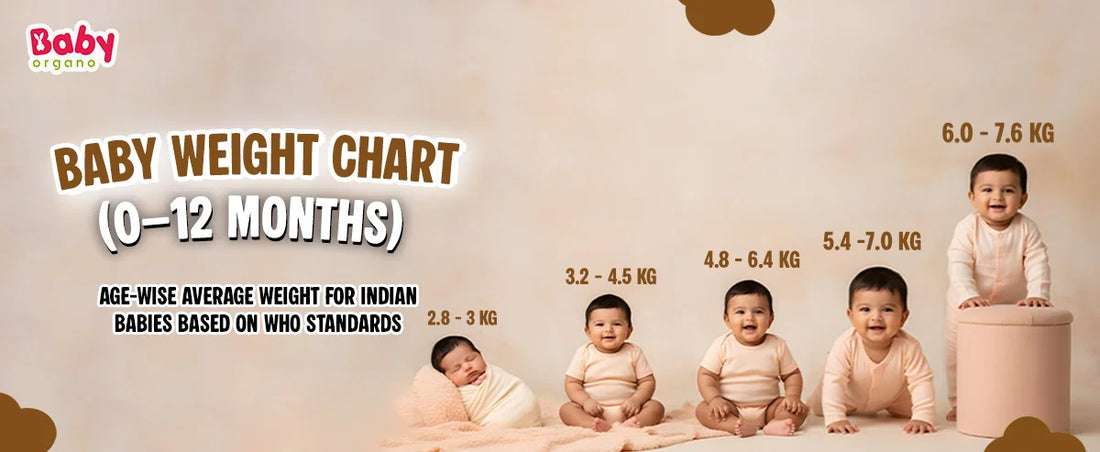
Indian Baby Weight Chart (Infographic)

If your baby’s weight gain seems slow, read our guide on how to help a child gain weight naturally.
Indian Baby Weight Chart (0-24 Months)
| Age (Months) | Boys Weight Healthy Range (kg) | Girls Weight Healthy Range (kg) | Growth Milestone / Tip |
|---|---|---|---|
| Birth | 2.5 – 4.3 | 2.4 – 4.2 | Birth weight is the foundation. |
| 1 Month | 3.4 – 5.7 | 3.2 – 5.4 | Focus on breastfeeding/feed cycles. |
| 2 Months | 4.3 – 7.0 | 3.9 – 6.5 | Baby starts holding head for seconds. |
| 3 Months | 5.0 – 7.9 | 4.5 – 7.4 | Major Growth Spurt Period. |
| 4 Months | 5.6 – 8.6 | 5.0 – 8.1 | Reaches for toys and laughs. |
| 5 Months | 6.1 – 9.2 | 5.5 – 8.7 | Rolling from tummy to back. |
| 6 Months | 6.4 – 9.7 | 5.8 – 9.2 | Introduction to Solid Foods. |
| 7 Months | 6.7 – 10.2 | 6.1 – 9.6 | Sits without support; very active. |
| 8 Months | 7.0 – 10.5 | 6.3 – 10.0 | Starts crawling or scooting. |
| 9 Months | 7.2 – 10.9 | 6.6 – 10.4 | Understands "No" and simple signs. |
| 10 Months | 7.5 – 11.2 | 6.8 – 10.7 | Pulls up to stand using furniture. |
| 11 Months | 7.7 – 11.5 | 7.0 – 11.0 | Starts "cruising" (walking while holding onto furniture). |
| 12 Months | 7.8 – 11.8 | 7.1 – 11.3 | 1st Birthday! Baby's weight usually triples from birth weight. |
| 13 Months | 8.0 – 12.1 | 7.3 – 11.6 | Attempts first independent steps; stands alone for a few seconds. |
| 14 Months | 8.2 – 12.4 | 7.5 – 11.9 | Improved finger coordination; starts attempting to self-feed. |
| 15 Months | 8.4 – 12.7 | 7.7 – 12.2 | Can squat to pick up a toy and stand back up without falling. |
| 16 Months | 8.6 – 13.0 | 7.8 – 12.4 | Enjoys stacking blocks and showing intense curiosity about surroundings. |
| 17 Months | 8.8 – 13.2 | 8.0 – 12.7 | Vocabulary expands; starts using 3–5 clear words to communicate. |
| 18 Months | 8.9 – 13.5 | 8.2 – 13.0 | Highly Active: Starts running and climbing; calorie burn increases. |
| 19 Months | 9.1 – 13.8 | 8.4 – 13.3 | Begins to show strong preferences for specific toys, foods, or clothes. |
| 20 Months | 9.3 – 14.0 | 8.5 – 13.6 | Starts using a spoon more effectively, though mealtimes may remain messy. |
| 21 Months | 9.4 – 14.3 | 8.7 – 13.8 | Can follow simple two-step verbal instructions (e.g., "Pick up the ball and give it to me"). |
| 22 Months | 9.7 – 14.7 | 8.9 – 14.1 | Learns to jump with both feet off the ground; loves physical play. |
| 23 Months | 9.8 – 15.0 | 9.1 – 14.4 | Starts forming simple two-word sentences (e.g., "Want milk" or "Dada go"). |
| 24 Months | 9.9 – 15.3 | 9.2 – 14.8 | 2nd Birthday! Very active toddler with a steady walking and running gait. |
This is useful for moms and dads in tracking the averages for weight. Of course, slight differences from one week to another are expected and vary from baby to baby based on their genes, diet, and activity levels. The most important consideration is the growth rate.
This weight chart is developed on WHO standards and further adjusted for Indian children taking into consideration their feeding habits and genetic factors.
1 Month Baby Weight in kg
The normal weight range for a 1 month old baby usually falls between 3.2 kg and 4.5 kg.
During the first few days after birth, most babies lose 7-10% of their birth weight. Doctors consider this normal because newborns lose extra fluid after delivery.
By the end of the first month, babies typically regain their birth weight and start gaining steadily.
Feeding tip: Babies usually feed 8-12 times per day at this stage. If your baby produces 6-8 wet diapers daily, feeding is likely adequate.
2 Months Baby Weight in kg
The typical weight range for a 2 months old baby is 4.0 kg to 5.6 kg.
Around this time, babies experience their first major growth spurt. Many parents notice fuller cheeks, stronger crying sounds, and longer sleep stretches.
Some babies feed more frequently during this phase. Doctors call this cluster feeding. It does not mean your milk supply is low. Babies simply need extra nutrition during rapid growth.
3 Months Baby Weight in kg
A 3 months old baby usually weighs between 4.8 kg and 6.4 kg.
This stage brings exciting developmental changes. Babies begin smiling socially, recognizing familiar faces, and following objects with their eyes.
Parents sometimes compare babies with relatives’ children. However, genetics strongly influence body type. Some babies look lean but remain energetic and healthy.
4 Months Baby Weight in kg
The normal weight range for a 4 months old baby is 5.4 kg to 7.0 kg.
Babies become more active at this stage. Many start rolling, kicking, and pushing up during tummy time.
Because activity increases, weight gain may slow slightly compared to earlier months. This change reflects healthy physical development.
5 Months Baby Weight in kg
Most 5 months old babies weigh between 6.0 kg and 7.6 kg.
Babies become more curious and responsive during this phase. They recognize familiar faces, laugh during playtime, and show interest in surrounding objects.
Some babies also show early signs of readiness for solid foods. These signs include sitting with support and watching others eat. However, experts usually recommend introducing solids around six months.
6 Months Baby Weight in kg
The healthy weight range for a 6 months old baby is 6.5 kg to 8.2 kg.
This stage marks an important milestone. Many babies start solid foods along with breast milk or formula.
Milk still provides most of the nutrition during this phase. Solid foods mainly help babies learn new tastes and textures.
If you want to know what foods support healthy growth at this stage, read our detailed 6 Month Baby Food Chart for Indian Babies.
7 Months Baby Weight in kg
A 7 months old baby typically weighs between 6.8 kg and 8.7 kg.
Most babies can sit without support at this stage. Increased movement means babies burn more calories, so weight gain may slow slightly.
Parents can introduce iron-rich foods such as ragi porridge or mashed lentils to support healthy growth.
You can also explore our 7 Month Baby Food Chart to learn what foods help babies gain healthy weight.
8 Months Baby Weight in kg
The normal weight range for an 8 months old baby is 7.0 kg to 9.2 kg.
Many babies begin crawling around this time. Increased movement requires energy, which sometimes makes babies appear leaner.
This change usually indicates healthy physical development rather than poor weight gain.
For a complete feeding guide, check our 8 Month Baby Food Chart for Indian Babies.
9 Months Baby Weight in kg
A 9 months old baby usually weighs 7.3 kg to 9.6 kg.
Babies become highly interactive during this stage. They clap, babble, and respond when someone calls their name.
Parents often introduce soft finger foods at this age. These foods encourage self-feeding and help babies develop coordination.
Parents can explore our 9 Month Baby Food Chart for a full meal plan.
10 Months Baby Weight in kg
Most 10 months old babies weigh between 7.5 kg and 10.0 kg.
Babies stay extremely active during this phase. Crawling, standing, and cruising along furniture increase energy use.
Small, nutrient-dense meals can help maintain steady growth.
To learn which foods provide the right nutrition during this active stage, read our 10 Months Baby Food Chart for Indian Babies.
11 Months Baby Weight in kg
A 11 months old baby typically weighs 7.8 kg to 10.4 kg.
Many babies take their first independent steps during this period. Appetite patterns may change frequently because babies become busy exploring the world around them.
Parents should focus on balanced meals and consistent feeding routines.
You can also explore our 11 Months Baby Food Chart for Indian Babies for meal ideas that support steady growth before the first birthday.
12 Months Baby Weight in kg
The typical weight range for a 12 months old baby is 8.0 kg to 10.8 kg.
By their first birthday, most babies weigh about three times their birth weight. Babies also appear leaner because mobility increases.
At this stage, babies transition gradually toward soft family foods while continuing milk feeds.
As your baby transitions to family foods, our 1 year / 12 Months Baby Food Chart for Indian Babies can help you plan balanced meals for your toddler.
My Perspective: Why Your Baby’s "Prakriti" Matters
Many Indian parents worry when they see a "lean" baby compared to a neighbor's "chubby" one. In Ayurveda, we look at the Prakriti (Body Constitution) of the child.
Vata-Prakriti Babies: These children are naturally lean and active. They may gain weight slowly but are very energetic.
Kapha-Prakriti Babies: These babies tend to be chubbier and have a more solid build.
My Advice: If your baby is active, meeting milestones, and has a good appetite, being "lean" is not a medical problem—it's likely their natural constitution. To understand which body type your baby has, you can read my detailed guide on Understanding Vata, Pitta, and Kapha in Kids.
How to Use This Indian Baby Weight Chart
Step 1: Look for your baby's present age in months
Step 2: Compare their weight to the healthy range column
Step 3: Look for consistent growth, not the exact number
Step 4: Consult your pediatrician if weight drops suddenly or plateaus for 2+ months
Pro Tip: Download and print this chart to help track your baby's weight at home in between doctor visits.
Download Free Printable PDF Chart
Key Differences: Indian Baby Weight Chart vs. WHO Standards
Indian babies may weigh a bit less compared to the WHO global average because of the following reasons:
- Genetic factors: Parental height and build significantly influence baby weight
- Dietary patterns: Vegetarian diets are more common in Indian households
- Birth weight differences: Indian newborns typically weigh 200-300g less than Western averages
This chart has taken WHO standards and modified them to suit Indian contexts, yet with medical accuracy. These ranges accommodate regional variations in diet, genetics, and traditional feeding practices.
Why Baby Weight Matters Most in the First 12 Months
The first year of life is the most vulnerable period of growth because your child’s body and brain are developing very quickly. Proper weight gain during the first year promotes the development of the brain, leading to the formation of neural connections critical for learning, memory, and emotional control.
Proper weight gain also boosts the baby’s immunity, as they become able to combat infections effectively, especially during their first exposure to the environment.
Organ development might be considered another significant area where weight plays an important part. During the initial 12 months, comprehensive development occurs for organs such as the heart, lungs, digestive tract, and muscles.
Weights that are lower than what is expected might sometimes denote deficiencies in diet, impacting organ development. There might be undue importance given to weight.
Month-Wise Baby Weight Gain (0–12 Months)
0–3 Months – Rapid Growth Phase
During the first three months, babies experience the fastest weight gain of their life. Most babies gain around 150–200 grams per week after the initial post-birth weight loss. Breast milk or formula is the sole source of nutrition, and frequent feeding is completely normal.
What to expect: Your baby may feed 8-12 times per day. This is normal and supports their rapid growth phase.
4–6 Months – Steady Weight Gain
Between four and six months, weight gain becomes more gradual, about 100–150 grams per week. Babies grow longer, muscles strengthen, and fat distribution changes. Milk intake remains the primary nutrition, though many babies show readiness for solids around six months.
Parents commonly worry when weight gain slows compared to earlier months. This slowdown is expected as growth evens out. Babies become more active, kick more, and burn more energy.
7–9 Months – Growth Slows, Activity Increases
This phase marks increased movement, rolling, crawling, and sitting. Weight gain slows to 80–120 grams per week as activity rises. Complementary foods begin to contribute meaningfully, though milk still provides major nutrition.
Indian context: This is when many families introduce khichdi, mashed dal-rice, and ragi porridge.
10–12 Months – Transition Phase
In the last quarter of the first year, babies start family foods. Weight gain further slows to 60–90 grams per week. Babies appear leaner as they walk, stand, and explore constantly.
Milestone note: Most babies take their first steps between 10-14 months, which increases energy expenditure.
Is My Baby Underweight or Normal?
Small babies do not have to be weighing less than normal. Inheritance is a very important factor; if the parents are thin, this is probably what their offspring will be too.
One of the misconceptions about babies is that a stout infant is always healthier than an energetic one. The truth is, a smart, active infant who is achieving developmental milestones could potentially weigh less than a chubby infant, yet still be as healthy as can be.
Common Reasons Indian Babies Don’t Gain Enough Weight
There are a number of real-world considerations which impact the way Indian infants gain weight.
- Starting late on solids or using thin and watery consistency meals will cut down on calories. The fear of fat means a remarkably low usage of ghee or oil.
- Infections occurring regularly, especially when convertible from seasons, influence the diet and mechanism of absorption. The digestive sensitivity might hinder the increase in winter.
- Other issues include distractions during feeding, refusal of force-feeding, and inconsistent feeding times.
These issues are normally dealt with in a gentle and persistent manner.
Feeding Tips to Support Healthy Weight Gain
Provide textures according to age -
- smooth pastes at six months.
- mashed food at eight months.
- soft family foods at ten months.
Add ghee or cold-pressed oil to the food.
Mix foods effectively: cereal with dal, vegetables with fats, fruits with nuts (age appropriate). Continue with milk feeds as well.
Natural Superfoods: Include nutrient-dense Indian foods like Ragi (Nachni), Makhana, and Kerala Banana powder. You can find my recipes for these in our Ayurvedic Baby Food Guide.
Refrain from force-feeding the baby. Responsive feeding increases hunger and trust. Pay attention to hunger cues and keep mealtimes relaxed and centered on consistency and not quantity.
When Should Parents Worry About Baby’s Weight?
Consult your pediatrician immediately if you notice:
- No increase in weight for a period of two months.
- Sudden drop in percentiles.
- Loss of energy.
- Milestones being delayed.
- Often vomiting or usually diarrhea.
- Refusal of feeds.
- Fewer than 6 wet diapers per day (dehydration sign).
Remember: Specialists monitor the growth pattern instead of the numbers. Careful observation helps to ensure support at the right time while avoiding fear.
Urgent Note: Always consult your pediatrician if weight loss is accompanied by persistent diarrhea, vomiting, or a fever.
Conclusion
Think of this chart as a compass, not a final destination. Your baby’s health is measured by their smiles, their energy, and their curiosity. Use this Indian Baby Weight Chart as a helpful tracker, but always trust your motherly instinct and your doctor’s clinical advice.
FAQs
1. What is normal kg baby weight?
Normal baby weight varies by age and genetics. At birth, 2.5–3.8 kg is common. By one year, most babies weigh between 8–11 kg. Steady growth matters more than exact numbers.
2. What is the weight of a 9 months old baby boy in kg?
On average, a 9-month-old baby boy weighs around 8.5–9 kg. Healthy ranges vary, and active babies may weigh slightly less while still being healthy.
3. Is 2.7 kg baby girl normal?
Yes, 2.7 kg can be normal for a newborn baby girl, especially if born slightly early or to smaller parents. Doctors assess feeding and post-birth weight gain.
4. How much does a 1 month old weigh?
Most 1-month-old babies weigh between 3.2–4.5 kg. Babies usually regain birth weight by two weeks and then gain steadily.
5. How much weight should increase in 1 month?
In early months, babies gain about 600–900 grams per month. Weight gain slows gradually as activity increases.
6. Do breastfed babies gain weight slower?
Breastfed babies may gain weight differently but are healthy. They often gain rapidly early and slow later compared to formula-fed babies.
7. What are the signs of a healthy baby weight?
Good energy, steady growth, milestone achievement, normal feeding, and adequate wet diapers indicate healthy weight.
Disclaimer: This information is for educational purposes only and should not replace professional medical advice. Always consult your pediatrician for personalized guidance on your baby's growth and development.
- Tags:
- Parenting tips


%20%7C%206%20Month,%203%20Month%20%26%20All%20Ages%20in%20kg)