 Skip to content

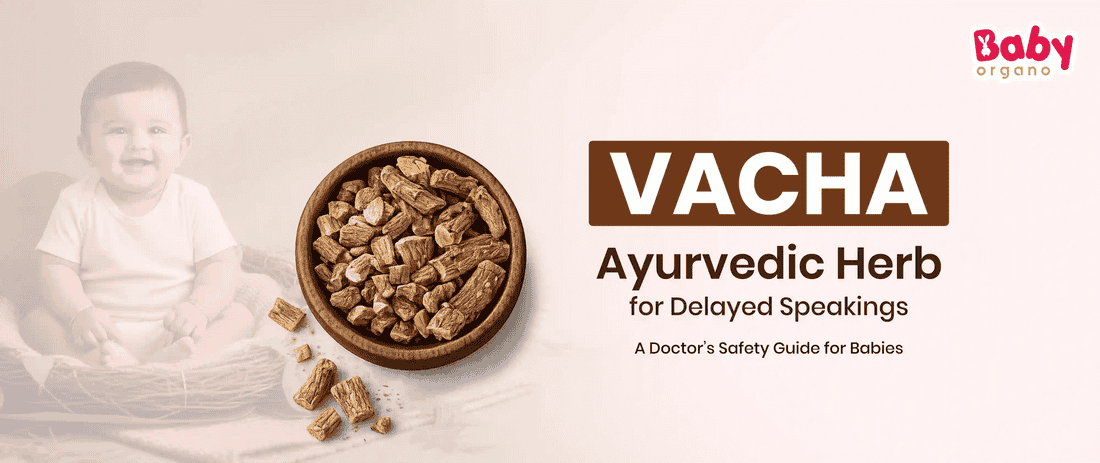
Vacha for Babies: A Doctor’s Guide to Benefits, Safety, and Ayurvedic Uses
- Written by Dr. Rajshree Singhatiya
- 3 min read
- Expert Medically Reviewed by Dr. Urvi Ashani, M.Pharm (Ayurveda), Ph.D | R&D Head, BabyOrgano | 13+ Years Experience in Pediatric Ayurvedic Care
Table of Contents
वचा (Vacha) – नाम और गुण
अथ वचाया नामानि गुणाँश्चाह
वचोग्रगन्धा षडग्रन्था गोलोमी शतपर्विका । क्षुद्रपत्री च मङ्गल्या जटिलोग्रा च लोमशा ।।१०२।। वचोग्रगन्धा कटुका तिक्तोष्णा वान्तिवह्निकृत् । विबन्धाध्मानशूलघ्नी शकृन्मूत्रविशोधिनी ।।अपस्मारकफोन्मांदभूतजन्त्वनिलान्हरेत् ।।१०३।।
वच के नाम तथा गुण-वचा, उग्रगन्धा, षड्ग्रन्था, गोलोमी, शतपर्विका, क्षुद्रपत्री, मङ्गल्या, जटिला, उम्र और लोमशाा ये सब नाम वच के हैं। वच-उग्रगन्ध युक्त, तिक्त तथा कटुरस वाली, उष्णवीर्य, वमनकारक, अग्निजनक, विबन्ध, आध्मान और शूल को नष्ट करने वाली एवं मल तथा मूत्र का शोधन करने वाली होती है। एवम् मिर्गी, कफ, उन्माद, भूतबाधा, कृमि तथा वायु को भी दूर करने वाली होती है। [१०२-१०३]
The Traditional Mystery of “Ugra-Gandha”
With around 5+ years of experience in practice, I often find parents confused about "Vacha-Mala" rituals as per traditions followed. While grandmothers confidently recommend it, many parents hesitate because they are uncertain about its safety.
So let’s understand it clearly:
Vacha (Acorus calamus) is known in Ayurveda as "Ugra-gandha", meaning “the one with a strong aroma”. If you’ve ever smelled Vacha root, you’ll recognize its sharp fragrance.
Vacha is renowned as a natural tonic for "Vaak" (speech) and "Buddhi" (intellect). It is classified as a Medhya herb. A Medhya herb assists cognitive functions and mental clarity.
Vacha is a powerful herb, but caution must be taken in using the herb. The purpose of this blog is to assist you in understanding the use of Vacha properly.
Vacha for Speech Development
One of the most common concerns that I hear from parents is:
Doctor, my child is not speaking yet. Should I worry?
Although every child learns and grows at his/her own pace, Ayurvedic support is available in the form of herbs like Vacha.
Although every child grows at their own pace, while using Ayurvedic support like Vacha, you should also follow active ways to How to Encourage Your Baby to Talk? through daily interaction.
According to Ayurveda, timid speech or unclear articulation of words is sometimes because of excessive Kapha in the tongue and throat areas, since Kapha stands for heaviness or stagnation.
Vacha has sharp and stimulating properties which reduce the feeling of heaviness. It is said to remove minor blockages and help with expression.
In practice, Vacha can be used for children who:
- Are slowly reaching speech milestones
- Have unclear pronunciation
- Show delayed verbal expression
It does not force speech. It simply aids in clarity and coordination.
Vacha also helps to enhance mental sharpness. A sharper mind can express itself more clearly. Hence, it is traditionally regarded as a stimulant for both speech and intellect.
Digestive & Respiratory Benefits
Vacha is not only helpful for speech support but also provides digestive and respiratory benefits.
Infants sometimes suffer from gas, bloating, and colic. Vacha possesses natural digestive stimulants, which help with discomfort. It supports digestive fire without overly heating when used in purified form and correct dosage.
Many traditional families keep their babies adorned with a "Vacha necklace" which contains aromatic essential oils. If a child wears a small piece of Vacha root around their neck, they will be breathing in its mild scent all the time.
This is believed to:
- Keep the respiratory passages clear
- Support Chest Health through Seasonal Changes
- Reduce Kapha Accumulation
It does this through inhaled rather than ingested means, making it a more benevolent approach to newborn children.
Why Should You Use Purified Vacha Only?
This part is the most important.
The available Raw Vacha in the market is quite sharp in nature. When applied directly, there may be irritation in the stomach.
Raw Vacha is not suitable for babies. Shodhit (Purified) Vacha only should be used
The Purification (Shodhana)
Traditionally, purification of Vacha goes through three steps:
- The roots are cleaned thoroughly
- They are boiled in milk or water.
- They dry them to remove any impurities as well as excess sharpness.
This process makes the herb safer and gentler.
Doctor’s Tip:
It should be noted that oral intake is usually advised for babies who have started taking solids (i.e. 6-12 months and above), but in extremely small amounts.
External/ Inhalation methods are preferred for younger infants.
How to Use Vacha Safely?
One of the safest traditional methods is the Gharsana method.
Method:
- Take a clean, smooth stone (Sill).
- Take a small piece of purified Vacha.
- Add 1 drop of honey or ghee.
- Rub the Vacha gently on the stone just 2–3 times.
- The tiny trace of paste that forms is given to the baby.
The quantity should be extremely small.
Always use a carrier like ghee or honey (age-appropriate) to make it gentle on the baby’s stomach. Never give Vacha directly in powder form to infants.
Comparison: Vacha vs. Brahmi vs. Shankhpushpi
Parents often ask which herb is better. The answer depends on your goal.
| Herb | Main Strength | Best For |
|---|---|---|
| Vacha | Speech & Articulation Support | Clear speech development and delayed speaking |
| Brahmi | Memory & Learning Enhancement | Improving grasping ability and learning new concepts |
| Shankhpushpi | Focus & Calmness Support | Restless or overactive children needing better concentration |
Each herb has a specific role. Vacha is more targeted toward speech and expression, while Brahmi and Shankhpushpi focus more on learning and calming the mind.
Final Verdict
Vacha is what I call a "Precision Herb".
It is not for casual use. It is not for boosting everything at once. But when used correctly, in purified form and in proper dosage, it can be extremely beneficial, especially for speech clarity and mental sharpness.
However, herbs alone are never the complete solution.
If your child is a delayed speaking:
- Speak to them frequently
- Maintain eye contact
- Encourage interactive play
- Ensure proper nutrition
- Prioritize good sleep
Holistic development comes from lifestyle, environment, and support.
Reference:
Bhavaprakash Nighantu, Haritakyadi Varga, Shloka 102-103.
FAQs about Vacha
1. Does Vacha really improve memory?
According to Ayurveda, Vacha is a kind of Medhya herb, which supports intellect, clarity, and function of the brain. It could indirectly help memory by enhancing one's mental alertness; however, it is not primarily a memory-enhancing herb like Brahmi.
2. Can I give Vacha to my 2-month-old baby?
Oral use of Vacha is generally not recommended for very young infants, especially at 2 months of age. At this stage, a baby’s digestive system is still developing and can be sensitive. However, it is always best to consult a qualified Ayurvedic practitioner or pediatrician before using it for such young babies.
3. How do I identify Shodhit (Purified) Vacha?
Shodhit Vacha means the herb has gone through a traditional purification process to reduce its sharpness and make it safer for use. When purchasing, always choose a trusted Ayurvedic brand or pharmacy that clearly mentions "Shodhit" or purified Vacha on the label.
4. Can Vacha help my delayed speaking speak faster?
Vacha may support speech clarity and articulation when used properly and in the right quantity. It works by stimulating the tongue and throat area according to Ayurvedic principles. However, speech development depends on many factors such as regular interaction, talking to the child, reading aloud, proper hearing ability, and overall development.
5. What is the correct way to give Vacha?
The traditional method is called the Gharsana method. A small piece of purified Vacha is gently rubbed on a clean stone with a drop of ghee or honey to form a very tiny paste. Only a trace amount is given to the baby.
6. Why is Vacha called a Medhya herb?
Because it supports mental clarity, intellect, and cognitive function.
7. Are there side effects if given in excess?
Yes. Excess use may cause stomach irritation or discomfort. Dosage control is very important.
7. Can I give Vacha along with Brahmi or Shankhpushpi?
It can be combined in certain formulations under professional guidance. Each herb has a different strength and purpose.
Disclaimer: The information in this blog is for educational purposes only and is not a substitute for professional medical advice. Vacha is a potent herb; please consult a qualified Ayurvedic doctor or pediatrician before using it for infants. Avoid self-medication as every child’s health needs are unique.
- Tags:
- Parenting tips


